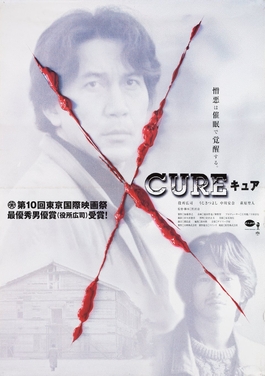
Cure (1997) Ending Explained: Decoding Kurosawa's Chilling Ambiguity
Kiyoshi Kurosawa's 1997 psychological horror masterpiece,
Cure, remains a monumental achievement in Japanese cinema, often cited as a foundational text for the modern J-horror wave. Far from relying on jump scares, the film meticulously crafts an atmosphere of creeping dread, philosophical inquiry, and existential unease. It's a slow-burn descent into the darkest corners of the human psyche, leaving audiences profoundly unsettled long after the credits roll. If you've just experienced its chilling conclusion, you're likely grappling with its deliberate ambiguity and potent implications. Let's unpack the ending of
Cure (1997): Kiyoshi Kurosawa's Foundational J-Horror Masterpiece and delve into its disturbing meaning.
The Genesis of Terror: What is Cure (1997)?
Set in a grim, rain-soaked Tokyo,
Cure (1997) introduces us to Detective Kenichi Takabe (Kōji Yakusho), a man perpetually on the brink, his personal life mirroring the bleakness of his professional one. He's investigating a series of increasingly bizarre and brutal murders: victims are found with a large "X" carved into their throats, yet the perpetrators are always different, ordinary individuals with no prior criminal records and no discernible motive. What's even more disturbing is their post-crime state: calm, cooperative, yet completely amnesiac about their actions, as if hypnotized or possessed.
The central puzzle piece arrives in the form of Mamiya (Masato Hagiwara), a mysterious drifter claiming extreme short-term memory loss. He constantly asks, "Who are you?" and "Where am I?", yet there's an unnerving intensity behind his vacant gaze. Takabe quickly suspects Mamiya isn't committing the murders himself, but rather orchestrating them through a deeply unsettling form of hypnotic suggestion, unlocking a primal, destructive impulse within his unsuspecting targets. This intricate setup transforms
Cure (1997) from a mere detective story into a profound exploration of human vulnerability and the thin veneer of sanity.
Takabe's Descent and the Unraveling Mind
As Takabe delves deeper into the labyrinthine case, his own sanity begins to fray. His wife suffers from a debilitating mental illness, and his home life is a desolate reflection of his internal state. The more time he spends interrogating Mamiya, the more insidious Mamiya's influence becomes. Mamiya's calm, unsettling presence, his repetitive questions, and his ability to subtly manipulate perceptions begin to erode Takabe's grasp on reality. Time blurs, memories distort, and the detective finds himself increasingly paranoid, struggling to differentiate between solving a case and becoming a part of the contagion himself. This psychological disintegration is a cornerstone of
The Existential Dread of Cure (1997): A Psychological Horror Analysis.
Kurosawa masterfully blurs the lines between reality and suggestion, making the audience question not just what is happening on screen, but also the very nature of human consciousness. Mamiya's power isn't about control in the conventional sense; it's about identifying and exploiting the inherent anxieties, repressed desires, and violence that lie dormant within everyone. He doesn't implant ideas; he simply removes the societal and personal barriers that prevent those dark impulses from surfacing.
The Confrontation and the False Sense of Resolution
The film culminates in a tense, chilling confrontation between Takabe and Mamiya in an abandoned hospital, a setting perfectly suited for the unraveling of minds. Here, Mamiya sheds his amnesiac facade, revealing a profound understanding of human nature. He suggests that his hypnotic abilities aren't a parlor trick, but a means to tap into a universal subconscious, awakening the "primal urge to kill" that he believes resides within everyone. He pushes Takabe, trying to strip away his defenses, to break him.
In a moment of apparent triumph and desperation, Takabe shoots and kills Mamiya. Initially, this act offers a fleeting sense of relief – justice served, the evil stopped. But Kurosawa is too clever, too cynical, to offer such a simple resolution. This "cure" is merely a temporary cessation, not an eradication.
Decoding the Chilling Final Scene: The Waitress and the Knife
The true horror of
Cure (1997) unfolds in its final, unforgettable moments. We see Takabe, seemingly calm, eating in a restaurant. A waitress serving him receives a phone call. After hanging up, her demeanor subtly shifts. Her face takes on a blank, unsettling expression. She walks slowly toward the kitchen, picks up a large knife, and walks off-screen. The film ends.
What does this terrifying sequence imply? The overwhelming interpretation is chillingly clear: **Takabe has absorbed Mamiya's technique and has become the new "carrier" of the insidious "curse."** His act of killing Mamiya wasn't an exorcism of evil, but a transfer of it. The power Mamiya wielded – the ability to unlock the latent violence in ordinary people – has passed to Takabe, perhaps through exposure, shared psychological torment, or even Mamiya's deliberate transfer of his "knowledge" in their final confrontation.
This ending suggests:
-
The Contagion of Violence: Mamiya's influence wasn't a unique phenomenon but a transmissible one. Violence, the film implies, is an infectious idea, a concept that can spread like a virus from one host to another, corroding society from within.
-
The Irony of the Title: The film's title, "Cure," becomes devastatingly ironic. There is no cure for the human condition, for the darkness that lurks beneath the surface. The "cure" is not an eradication of the disease but its perpetuation in a new form. This is particularly poignant given the film's original title, "Evangelist," which was changed to avoid religious cult connections after the Tokyo subway sarin attack, yet still carries the idea of spreading a message – a deadly one.
-
The Loss of Individuality: The waitress, like the previous perpetrators, is stripped of her agency. She becomes an empty vessel for a destructive impulse, highlighting the film's exploration of identity and the fragility of the self. Her mundane act of taking a call and then picking up a knife is far more terrifying than any overt supernatural threat, precisely because it suggests ordinary people can become instruments of terror.
Kurosawa's Ambiguity and Lasting Impact
Kiyoshi Kurosawa's genius lies in his refusal to offer easy answers. The ending of
Cure (1997) doesn't neatly tie up loose ends; instead, it leaves the audience to grapple with profound, unsettling questions about human nature, societal control, and the pervasive potential for malevolence. The horror isn't just external; it's internal, a reflection of what we might be capable of under certain influences.
The film's impact on subsequent J-horror and psychological thrillers is undeniable. It demonstrated that true fear could be evoked not through grotesque monsters or shocking violence, but through a slow, methodical dismantling of reality and the human psyche.
Insight for the Viewer: Cure challenges us to consider the hidden violence in ourselves and our societies. It asks: How much of our civil behavior is merely a fragile construct? What happens when the unspoken, primal urges are given permission to emerge? The film's enduring power lies in its ability to make us question our own mental fortitude and the social fabric that holds us together. It's a testament to how ambiguity, when wielded expertly, can amplify horror and provide a truly unforgettable cinematic experience.
Conclusion
Cure (1997) is not just a film; it's an experience that burrows into your subconscious. Its ending, far from providing closure, opens up a terrifying vista into the contagious nature of violence and the inherent darkness within humanity. Detective Takabe's journey culminates not in triumph, but in a chilling transformation, making him the new, unwitting evangelist of Mamiya's unsettling philosophy. Kurosawa's masterpiece ensures that the "cure" is not found, but the disease irrevocably spreads, leaving us to ponder the fragility of sanity and the ease with which our deepest fears can be weaponized.